Ceiling Installation
Using Diagonal Ceiling Grid Measurement to Find Racked Bays
A field method for finding and correcting racked suspended-ceiling modules while the open grid is still accessible.
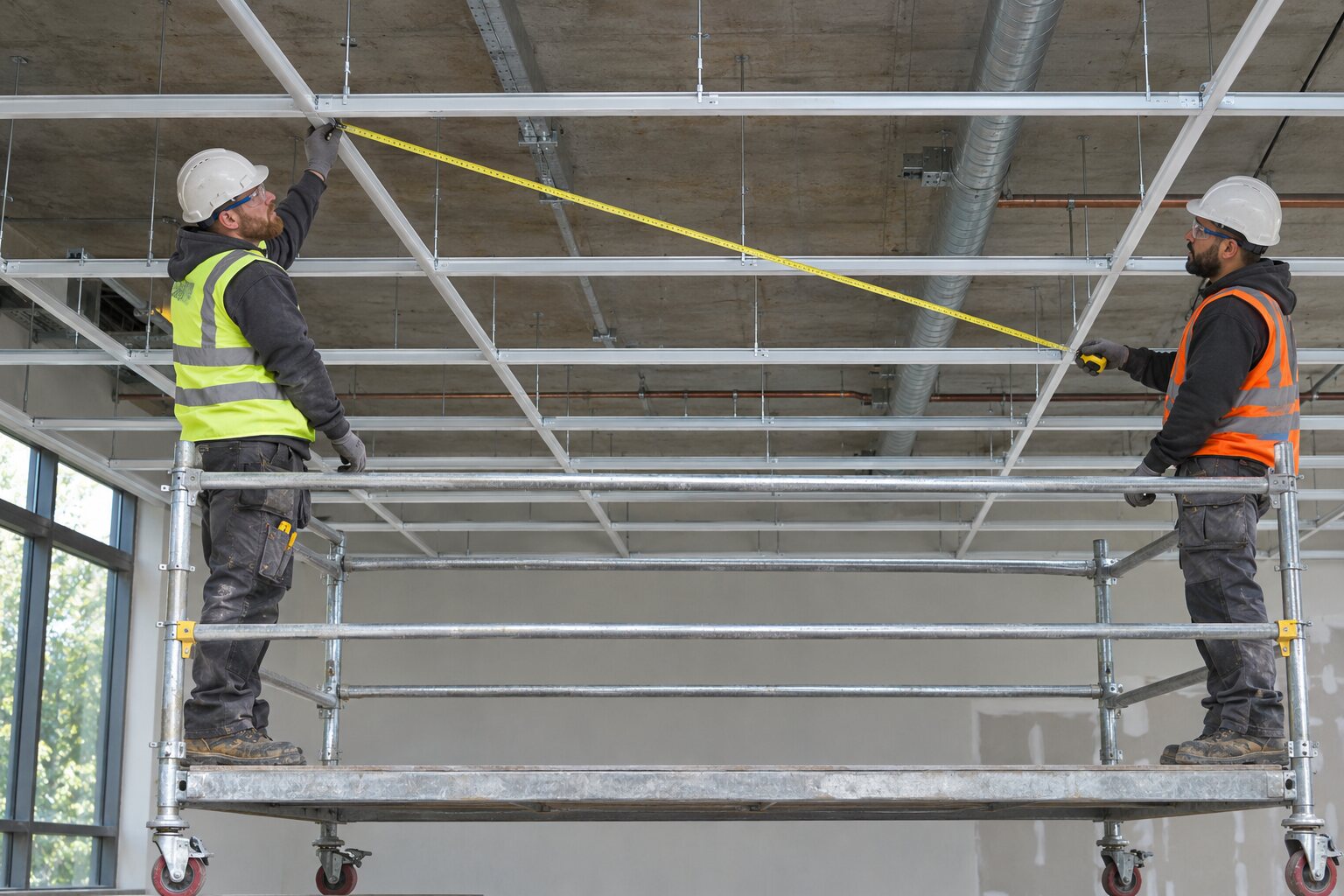
A rectangular bay can look right and still be racked
A tape stretched from one corner of an empty ceiling bay to the opposite corner can settle an argument that sightlines cannot. Diagonal ceiling grid measurement catches a racked rectangle while every connector remains visible and movable. From floor level, repeated white openings may look orderly even when one main tee has crept. The warning otherwise arrives later: a full tile binds at two corners, a border cut changes width along the wall, or a light no longer sits cleanly inside its planned module. That is too late for a convenient correction. Tile cartons are open, trades are working below the ceiling and several rows may already carry finished panels. A diagonal check gives the installer a simple geometric question while the grid remains visible: do the opposite corners describe the intended rectangle? It does not replace the approved ceiling layout, project tolerances or the grid manufacturer's instructions. It helps the crew locate where those requirements have stopped agreeing with the installed field.
Choose a reference bay that can lead the room
Do not start with the most awkward perimeter opening. Select a full, repeated module close to the established setting-out reference, usually within the first stable part of the field. The main tees should be at their intended level, cross tees should be positively connected, and the perimeter should not be carrying a temporary push from stored material or an unfinished service opening. A loose intersection cannot provide a useful reference, however carefully it is measured. Check the drawing and the actual component family before interpreting the bay. Chengyu's live product information describes painted ceiling T-grid as a coordinated package of main tees, cross tees and wall angle, with 15 mm and 24 mm exposed-face options. Those components should remain identified as one order group on site. A mixed cross tee, a connector that has not seated, or a substituted face-width series can create a local fit problem that resembles a layout error but will not be cured by pulling the whole ceiling sideways.
Measure both diagonals without bending the grid
Place the tape at one inside corner of the selected opening and read the opposite corner. Then repeat across the other diagonal using the same contact points. Keep the tape in the ceiling plane and apply only enough tension to remove sag. Pulling hard against a light T-profile can move the corner being checked and produce a reassuring number that disappears as soon as the tape is released. Equal diagonals are a practical indication that a rectangular opening is square. Armstrong's published suspended-ceiling instructions use this method on an early grid opening and direct installers to adjust the main when the two measurements differ. That example belongs to Armstrong's own system and dimensions; it should not be copied as a Chengyu tolerance. On another project, the approved layout and supplier guidance must define the acceptable result. The transferable lesson is to measure a controlled first area before repeating the grid across the room.
Trace the drift instead of forcing one cross tee
When the diagonals disagree, mark the bay and look beyond it. Sight along both main tees. Check whether corresponding cross-tee slots line up, whether connector ends are fully engaged and whether the border piece at the reference side was cut to the intended length. A grid can rack because the first main started out of position, because successive mains have crept along the room, or because a perimeter cut is holding one line away from its planned point. Avoid using one cross tee as a lever to disguise a wider error. Forcing a connector into a strained position may make the tape reading improve while leaving the exposed faces twisted or the next bay out of shape. Release only the connections and perimeter restraints allowed by the system instructions, correct the source of the drift, reconnect the field and measure again. If the cause involves the suspension, a service support or a project detail, stop and pass the issue to the responsible supervisor rather than improvising a new load path.
Repeat the check where the room changes character
One square bay does not prove a long room. Repeat the check after several modules and at places where the ceiling rhythm changes: beside a column return, beyond a main-tee splice, near a bulkhead, and on the far side of a coordinated light or diffuser zone. These are not automatically defects. They are points where short perimeter pieces, service clearances and different crews can interrupt the reference carried from the first bay. Repeat diagonal ceiling grid measurement after any adjustment that moves more than one line. Compare the corrected bay with its neighbor, then sight the exposed faces from the floor. The grid needs to be square, level and visually continuous as one field. A measurement record without that wider look can miss a kink along a main tee; a visual check alone can miss small accumulated drift that becomes obvious only when rigid tile modules begin to fill the ceiling.
Release an open grid that the tile crew can trust
A useful release is brief and local. Record the room or ceiling-zone reference, the bay used for the first diagonal check, any areas adjusted and the points that still await service coordination. Leave the grid open in those unresolved zones. The tile crew should be able to see which area is ready for full panels and which section must remain accessible, rather than discovering a hold point after cartons have been distributed across the room. For distributors and project buyers, the same clarity begins with the order description: state the main tee, cross tee, wall angle, module, exposed face width, finish, length and packing identity required for the ceiling package. Chengyu asks buyers to confirm project drawings, lengths, finishes, labels and packing details during review. A consistent package cannot guarantee site layout, but it removes avoidable product ambiguity. When the installed field, the order record and the diagonal checks tell the same story, tile loading can start without using finished panels as measuring tools.