Drywall Framing Coordination
Punched Drywall Studs for Cleaner Service Route Planning
How buyers and contractors coordinate punched drywall studs, tracks, service paths and bundle labels before gypsum board closes the frame.
Service routes should be planned before the wall closes
Punched drywall studs are a small detail until the first electrician, data installer or site supervisor asks where the services are supposed to pass. At that point, the wall frame is no longer just a line of galvanized profiles. It becomes a working space that has to hold gypsum board, keep the partition straight and still leave a sensible route for cables or light services before the boards cover everything. For overseas distributors, contractors and project buyers, the useful conversation starts before production and before site release. Chengyu's live product content describes light steel keel as the concealed framework behind gypsum board partition walls, wall linings and suspended ceilings. It also lists studs, tracks, furring channels and carrying channels, with OEM choices for profile width, flange, steel thickness, length, punching, surface finish, labels and export packing. Those choices belong together. A punched stud only helps the installer when its hole pattern, length and matching track have been considered as part of the wall package.
Start with the wall, not the hole
A service opening in a stud should follow the wall layout, not the other way around. The buyer should know whether the framing is for office partitions, corridor walls, wall lining, service rooms or repeated commercial fit-out spaces. Each room type changes the way services are likely to cross the frame. A low-level cable run in an office partition is a different site problem from a wall lining that is used to create a narrow service gap against an existing masonry wall. This is why a punched drywall stud enquiry should not be written only as a broad request for metal studs with holes. The quotation note should state the profile family, stud and track dimensions, required length, punching expectation, surface requirement, quantity and the way the material will be released. If a drawing or approved sample exists, it gives the factory a clearer basis for production review than a photograph of a finished wall.
Keep tracks and punched studs matched
The track sets the wall line and the stud carries the vertical rhythm. When the shipment includes punched and unpunched studs, several lengths, or different profile widths, the receiving team needs to see which parts belong together before the first bundles are opened. A correct count is not enough if the first room receives the wrong stud group and the matching track remains in another rack bay. Chengyu's product pages already ask buyers to confirm section dimensions, thickness, length, punching, finish, labels and packing. In practical terms, that means a punched stud package should be labeled so the warehouse and the installer can read it quickly. Profile name, length, punching status, quantity and order reference are plain details, but they prevent avoidable measuring and re-sorting when work is moving floor by floor.
Hole alignment affects real installation rhythm
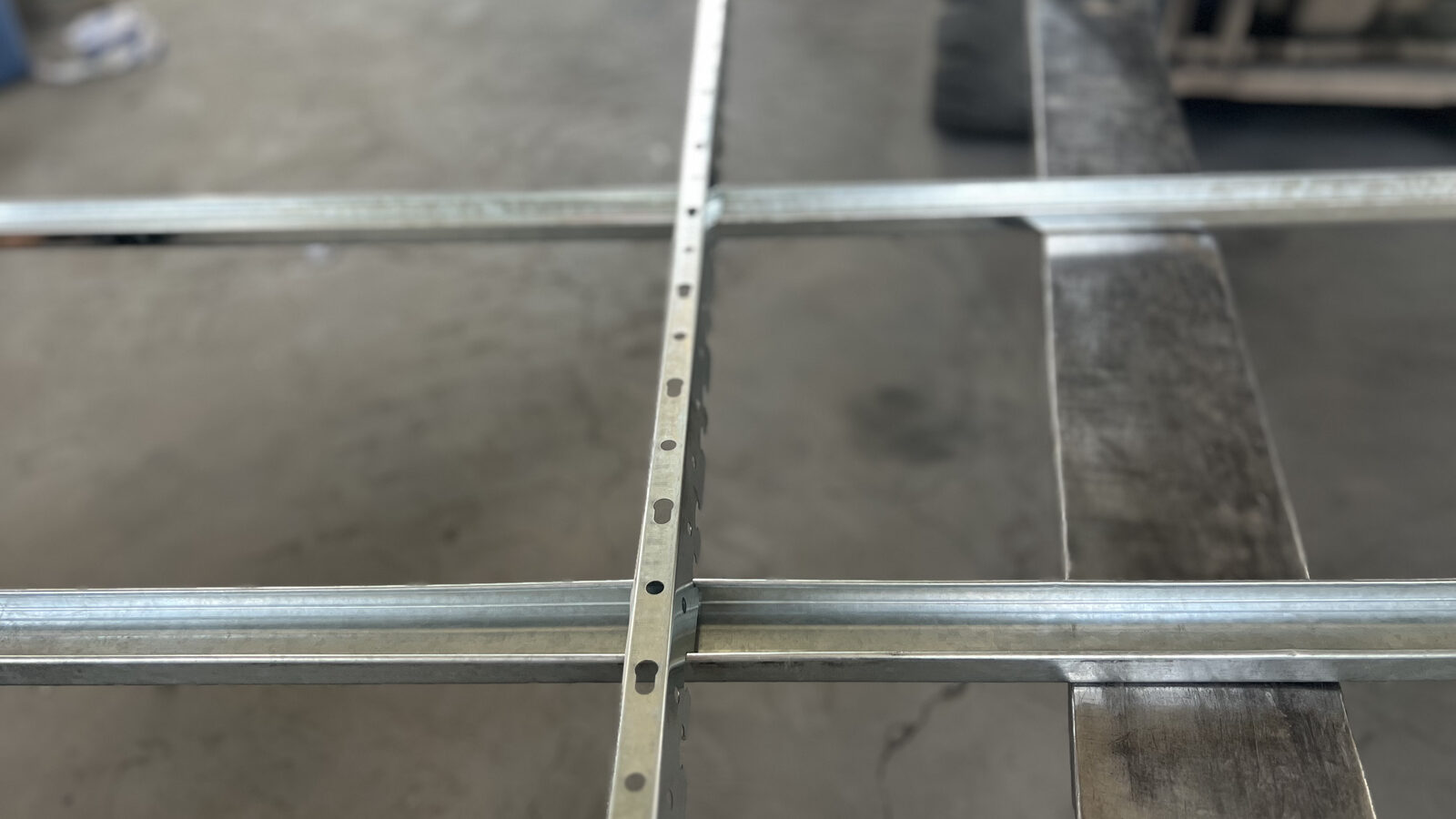
On site, installers do not want to search every stud for a usable opening after the frame is standing. They want a repeated pattern that makes sense across the wall while still respecting openings, corners, head tracks and any strengthened zones shown on the project drawing. A hole that looks acceptable on one loose sample may be poorly placed when it meets the actual board layout or service route. The selected image for this article shows punched galvanized framing members crossing other light steel profiles. It is not a finished partition, and that is the point. The service-route decision is made while the metal is still visible. Before board fixing, the crew can still check whether punched areas line up, whether special zones need unpunched members, and whether services can pass without forcing rough site cutting that was never part of the order.
Do not treat every opening as a cutting invitation
A punched stud is not permission to cut anywhere else in the frame. Once installers begin making extra openings without a plan, the wall can lose the clean logic that the procurement team tried to buy. Site cutting may still happen under the contractor's method and local requirements, but it should not replace a clear profile order, especially where repeated room types allow the service route to be anticipated. For project buyers, the better habit is to separate ordinary service routing from special framing areas. Door openings, wall ends, heavy fixture zones and partitions with unusual board build-ups may need different treatment from a simple field run. If those areas are known, they should be reflected in the drawing, material takeoff or release note rather than left for the installer to discover after several bundles have been opened.
Packing should preserve the installation sequence
Punched drywall studs are easy to mix once they are wrapped with similar galvanized profiles. A distributor may store them beside standard studs, tracks, ceiling channels or custom C and U profiles. A contractor may move them from the container to a warehouse and then to several floors. Every extra handoff increases the need for clear outer identification. Packing does not have to be elaborate. It has to protect long profiles, keep matched components together and keep the label readable until the installer is ready. For a repeated fit-out, room or phase marks can be useful. For distributor stock, plain product identity and punching status may matter more. The right answer depends on the next movement after unloading, so buyers should discuss it before production rather than after the container plan is already fixed.
A practical RFQ gives the factory fewer guesses
A strong punched drywall studs request is short but specific. State the application, profile drawing or dimensions, steel thickness, length, punching requirement, quantity, matching track, packing preference and destination port. Note whether the material is for direct project release or distributor stock. If the same order also includes furring channels, carrying channels, ceiling T grid or mineral fiber ceiling board, keep the item groups separated clearly in the schedule. This level of detail does not turn the buyer into the installer. It simply keeps the service route visible in the purchasing conversation. When punched drywall studs, tracks, labels and packing are coordinated before the frame reaches site, the wall crew can spend more time setting straight lines and less time decoding the bundle. That is the practical value: a drywall framing package that remains readable from factory production through board-ready inspection.