Site Handling
Mineral Fiber Ceiling Tile Handling Before Installation
How flat storage, dry-room timing and room-sequenced release protect mineral fiber ceiling tile before installation starts.
A clean ceiling can be spoiled on the floor
The first visible damage on a suspended ceiling often happens before the installer touches the grid. A corner gets crushed while cartons are shifted from one room to another. A stack is opened early and then moved twice because another trade still owns the area. Labels disappear, spare cartons are mixed, and by the time the tile crew starts, the material already looks older than the job. That is why mineral fiber ceiling tile handling deserves attention long before the first panel is lifted into an exposed T-grid. Chengyu's current website already presents mineral fiber ceiling board as part of a coordinated ceiling package for offices, schools, hospitals, hotels and other commercial interiors. The product range covers common modules such as 595 x 595 mm, 600 x 600 mm, 603 x 603 mm and 600 x 1200 mm, with square, tegular and revealed edges available to match the project. Those choices shape appearance, but they also shape handling. The more modules and room types a buyer combines under one order, the more carefully the board has to be received, stored and released.
Do not move standard tile into a wet room too early
Official ceiling manufacturers are consistent on one point: standard acoustical panels belong in enclosed interior conditions, not in spaces that are still behaving like active wet-work zones. Armstrong's handling guidance for standard mineral and fiberglass panels ties storage and installation to near-occupancy temperature and humidity, and USG's installation guidance similarly places ceiling panels after wet work is substantially complete. That is practical site advice, not laboratory theory. If moisture-heavy work is still drying out overhead or nearby, the ceiling tile has arrived too early for the room even if it has arrived on time for the project. For overseas buyers and distributors, that changes how site release should be planned. Delivery to the project is not the same thing as release to every room. Large field areas may be ready while washrooms, service corridors or rooms waiting on paint touch-up are not. When standard mineral fiber board is pushed into those unfinished spaces anyway, the cartons become part of the congestion. Good handling starts by holding material in a dry, controlled interior zone until each room is genuinely ready to receive ceiling work.
Flat stacks and clear labels save labor later
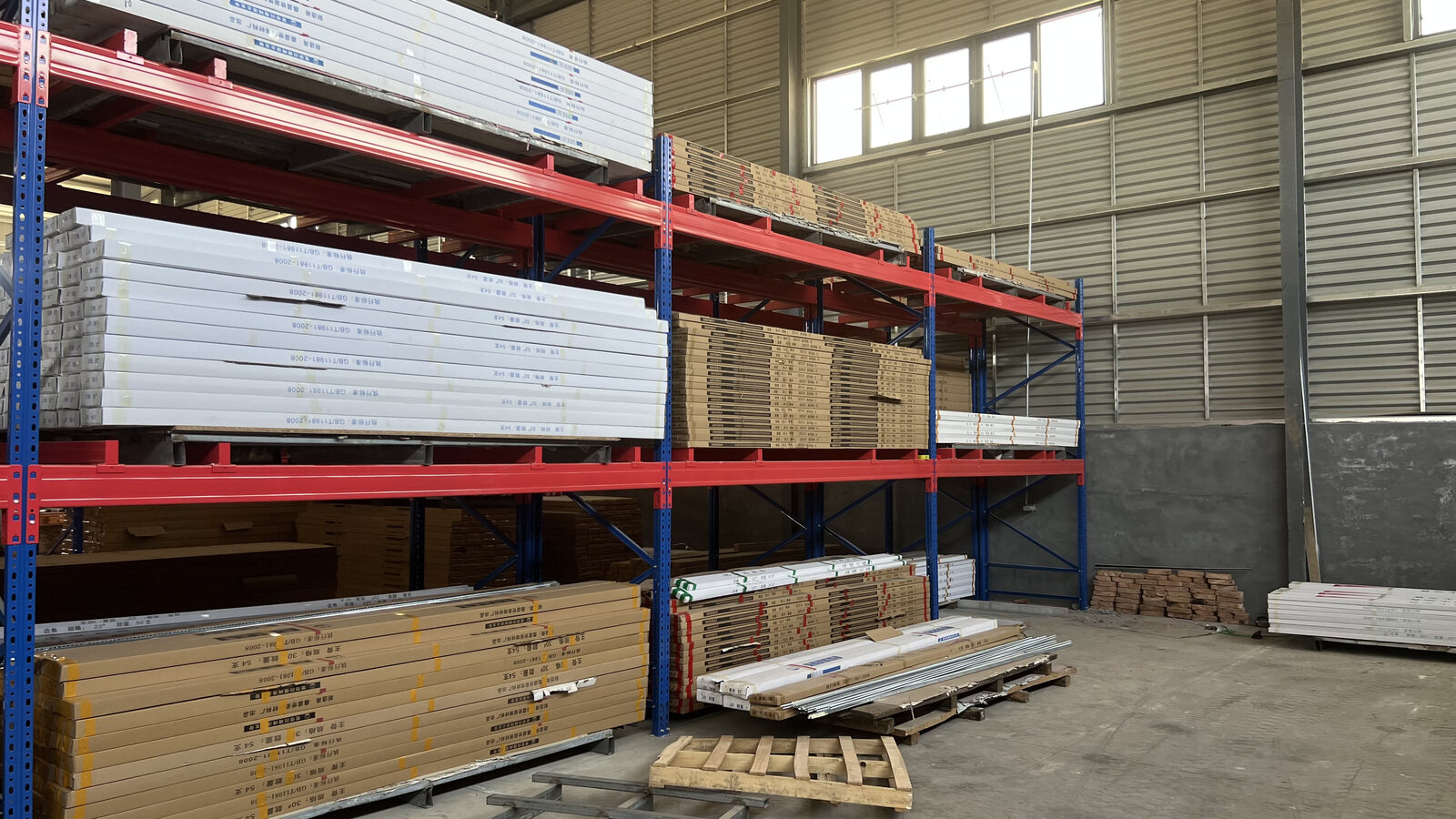
The shared-drive warehouse photo makes the next point easy to read. Mineral fiber ceiling tile handling works better when cartons stay flat, level and identifiable. Once a stack is leaned against a wall, broken into uneven piles or opened without a release plan, the crew loses both control and confidence. Corners are more exposed, counting slows down and every later move adds another chance to rub edges or crush a carton face. A calm receiving area usually looks ordinary: straight stacks, visible labels and enough aisle space that the right pallet can be taken without disturbing the rest. Label clarity matters more than many purchasing teams expect. Chengyu's own ceiling-board range includes more than one module and more than one edge style, while the matching grid package may change between 24 mm and 15 mm exposed faces. If the receiver cannot tell one carton group from another at a glance, the site starts opening packs for identification instead of for installation. That is a poor trade. Good mineral fiber ceiling tile handling keeps the carton face working as a decision tool right up to the moment the installer needs the material.
Release board by room sequence, not by empty corner
A frequent site mistake is to use tile cartons as flexible stock that can be dropped wherever temporary space appears. That approach looks efficient for a day and creates disorder for weeks. Commercial projects rarely install every ceiling in one uninterrupted sweep. Open offices, corridors, reception zones and support rooms often move at different speeds because lighting, air devices, inspection access or final wall finishes are not released together. If tile is issued only by where there was room to set it down, the next handoff becomes slower than it needed to be. A better habit is to release mineral fiber board by room family or installation phase. Keep standard field material together. Keep special modules or edge details tied to the rooms that use them. Hold spare cartons with the same identified group instead of throwing them into a general leftover pile. Buyers already do a version of this logic when they separate counts on the quotation. The handling stage should preserve that same logic instead of erasing it the moment the truck is unloaded.
Board and grid should travel as one package
Ceiling tile rarely fails alone. More often, the trouble shows up at the handoff between tile, grid and room release. Chengyu supplies painted T-grid systems in 24 mm and 15 mm face-width options, together with the mineral fiber board modules they support. If the board reaches the room before the receiving team has confirmed the matching exposed grid package, the installer ends up solving a procurement question with open cartons on the floor. That is when handling damage starts to look like an installation problem even though the real cause was coordination. Treating board and grid as one package keeps the review simple. Confirm the module, edge detail and grid face before the first stack is opened. Keep the tile for a given area close to the matched ceiling components that belong to that area. If a project uses more than one ceiling type, separate those packages visibly before site release. The less decoding the crew has to do in the room, the less unnecessary movement the tile sees before it reaches the grid.
A short handling review before the first tile is lifted
The best checkpoint is still a short one. Is the building enclosed? Is wet work substantially complete in the area that is about to receive tile? Are the cartons still flat, dry and clearly marked? Do the module, edge and grid-face selections match the room that is being released? Is spare stock identified before the first installation carton is opened? None of those questions sound dramatic, but they prevent the kind of small handling losses that quietly spoil ceiling work. Mineral fiber ceiling tile handling is a modest subject, which is exactly why teams tend to postpone it. Yet the condition of the ceiling on installation day is shaped by every storage and release decision that came before it. When cartons stay flat, rooms are released in a dry sequence and board travels with the right grid package, the installation crew starts with material it can trust. The finished ceiling then has a better chance of looking calm, consistent and intentional from the first room to the last.