Product Selection
Light Steel Keel Support Channel Selection for Ceiling Details
How buyers can describe C, U, Omega and related galvanized support profiles before ordering ceiling and drywall details.
Selection starts with the detail, not the profile name
Light steel keel support channel is a small phrase that can cover several real site conditions. One buyer may mean a C channel used with a suspended gypsum board ceiling. Another may be asking for a U channel, an Omega channel, a carrying channel or a special galvanized profile that belongs to a wall lining, partition edge or ceiling support detail. If those requests are handled as one loose product name, the order can look simple on paper and still create confusion when the cartons reach the installer. Chengyu lists light steel keel drywall partition systems, ceiling suspension profiles, drywall metal studs and tracks, plus C channel, U channel and Omega channel as custom galvanized metal profiles for ceiling, drywall and support structures. That product range gives overseas distributors and contractors useful flexibility, but it also puts more responsibility on the RFQ. The cleanest orders begin with the drawing detail, the room condition and the profile role, then move to size, thickness, length, punching, finish, label and packing.
Separate C, U and Omega roles early
C channel, U channel and Omega channel are not interchangeable just because they are all light-gauge galvanized profiles. A C-shaped member may be selected for one support condition, while a U-shaped member may act as a receiving track or edge member in another. Omega profiles are often discussed when a shallow fixing or lining detail is needed. The exact use still depends on the project drawing, local practice and installer method, so the order description should avoid promising more than the material can prove from a catalog line. For trade buyers, the practical question is straightforward: where will the channel sit, and what other material must it work with? If it belongs above a gypsum board ceiling, name the board side of the work and any carrying channel or hanger coordination required by the ceiling package. If it belongs in drywall framing, state whether it supports a wall lining, partition edge, service zone or other secondary framing point. If it is for distributor stock, record the most common room details that the stock is expected to serve.
Do not let a support profile become a generic accessory
Support channels are easy to treat as minor accessories because they are not as visible as a painted ceiling T grid or as familiar as a stud and track set. That habit causes problems. The installer handles the profile by its shape, length and fixing position, not by a purchasing category. A long carton marked only as accessories may hold the right metal and still slow the crew down because nobody can tell which room or detail it belongs to without opening and sorting the whole bundle. A better description gives each light steel keel support channel a clear job. Use plain language such as ceiling support channel, wall lining channel, receiving U channel, Omega furring profile or custom galvanized support profile when that language matches the drawing. Keep special profiles separate from standard studs and tracks. If punching is required, describe it as a separate condition instead of assuming every profile in the order should be punched. If the profile is plain, say that as well.
Match profile decisions to ceiling and drywall packages
Chengyu presents light steel keel as material for drywall partition walls, gypsum board suspended ceilings, interior wall lining, commercial fit-out and renovation. Those applications often share the same building, but they do not always share the same profile logic. A hotel corridor ceiling, an office partition, a service-area wall lining and a retail ceiling edge can all use galvanized metal profiles, yet the channel role, length and bundle grouping may be different. This is where overseas buyers can improve order control without making the RFQ complicated. Put the support-channel line beside the system it supports. A ceiling channel should be discussed with the ceiling framing package, not buried under a general metal accessory note. A drywall support profile should be linked to the stud and track family it works near. If mineral fiber board and painted T grid are also in the project, keep those exposed ceiling materials in their own release group so installers do not confuse grid trim with drywall support channels.
Use samples to remove shape and finish doubt
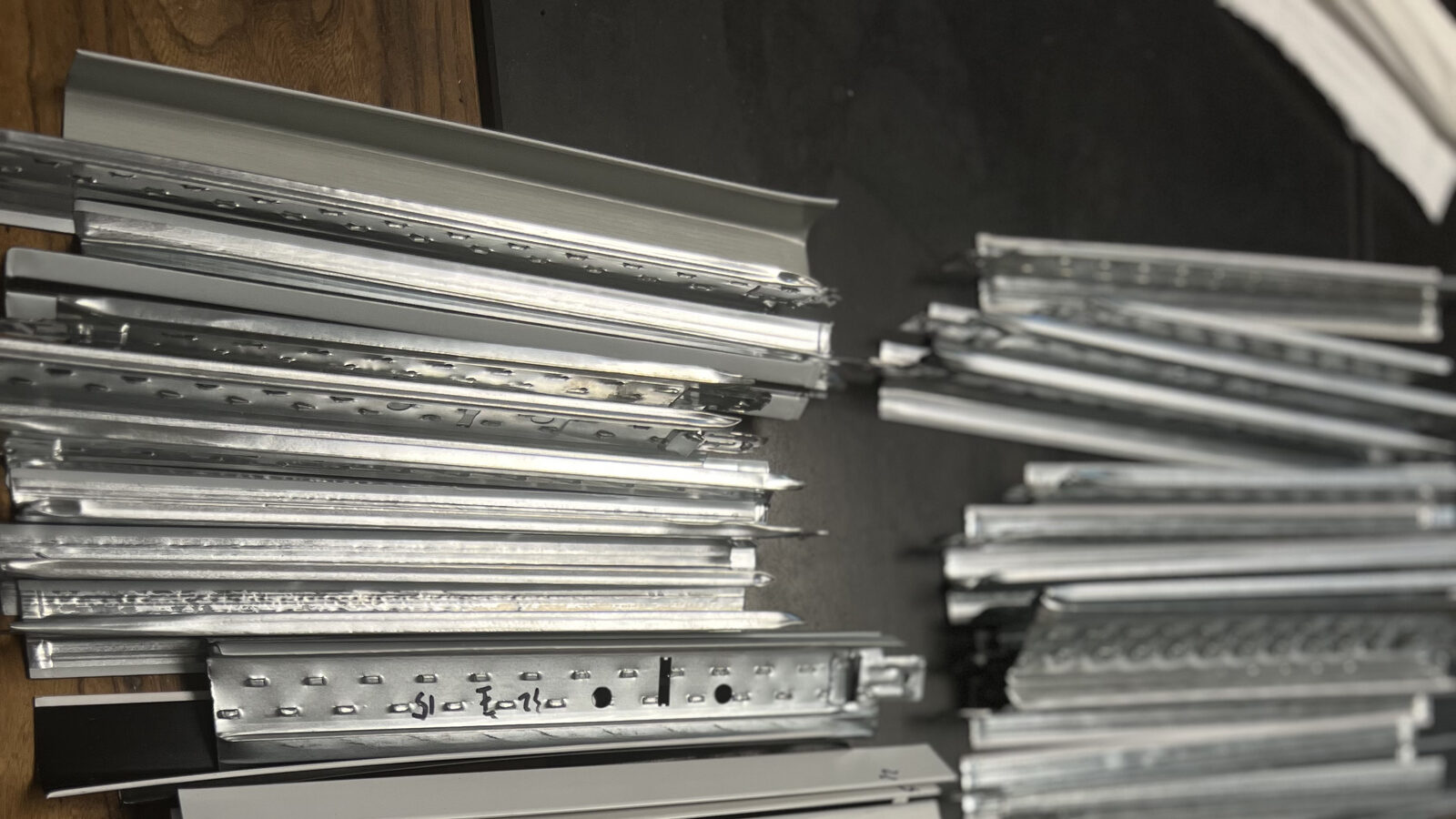
The sample stage is useful for support channels because small profile differences are difficult to describe by text alone. A buyer can compare flange shape, return edge, slot or hole pattern, surface finish and actual length before a repeat order is released. This does not turn the sample into a performance certificate. It simply gives the warehouse, purchasing team and installer the same physical reference. The selected article image shows galvanized profile samples laid out for review, including several shapes and short sections. It is a good fit for this topic because it shows the decision buyers often make before production: which profile family belongs to the detail? In a light steel keel support channel order, a clean photo, drawing or approved sample can prevent the wrong assumption from being copied into the next shipment.
Keep label language useful at receiving
Support profiles often arrive with other long materials, so label language matters. Chengyu already supports labels and export packing as part of the order conversation. Buyers should use that opportunity to make the carton readable in the receiving area. A label does not need to contain a long technical paragraph. It should identify the profile type, size, length, finish if relevant, quantity, and the room or stock group when the order is packed by release area. This is especially useful for distributors carrying several light steel profile families. Similar galvanized pieces can look alike when strapped in long bundles. Clear label language helps separate C channel, U channel, Omega channel, drywall studs, tracks and ceiling support items before the material is moved to rack storage or a jobsite holding area. That saves opening cartons only to confirm a shape that could have been named clearly on the outside.
What to send before asking for a quotation
A useful inquiry for light steel keel support channel should include the profile drawing or clear section photo, intended application, size, thickness method, length, punching requirement, finish, quantity, label language and packing preference. If the profile must coordinate with drywall studs and tracks, carrying channel, hangers, wall angle or gypsum board ceiling work, describe that relationship in the same email instead of leaving it for the installer to solve later. The point is not to overload the first RFQ. It is to make the profile role visible before production and packing. Contractors get material that can be sorted by detail. Distributors get stock descriptions that make sense to their sales and warehouse teams. Installers get fewer mystery bundles on the floor. For a product that often sits behind the finished board, the best support-channel order is one where the decision stays clear long after the quotation is approved.