Product Selection
Drywall Metal Stud Selection for Room-by-Room Fit-Outs
How buyers match stud, track, punching and bundle release to different interior room families.
Selection starts before the quote line
Drywall metal stud selection is often treated as a line item, but on real fit-out work it behaves more like a coordination decision. A buyer may order one family of galvanized studs and tracks for the whole building, then discover that the office partitions, corridor runs and service rooms do not ask the same questions from the framing package. Some walls are long and repetitive. Some stop and start around doors. Some carry more service routing. Some are handled by crews that receive only a small release from a distributor's warehouse. The material can be correct on the invoice and still be awkward on site if the selection conversation stays too general. Chengyu's current product content gives buyers the practical starting point. The website lists drywall metal studs and tracks in galvanized steel, with options for width, flange height, gauge and length. It also presents light steel keel products for drywall partition walls, gypsum board suspended ceilings, interior wall lining, commercial fit-out and renovation. Those facts point to a simple purchasing habit: choose the stud-and-track package from the way the rooms will be built, not only from the way the product is named.
A room schedule is more useful than a generic wall description
The first mistake is to ask for drywall framing as if every wall on the project has the same job. A straight office divider, a hotel corridor wall, an apartment partition and a small back-of-house enclosure may all use galvanized metal framing, but they do not move through procurement and installation in the same way. One room family may repeat for many floors. Another may include more door frames, corners and short returns. A service room may need more attention to openings and later access by other trades. For overseas distributors, the room schedule helps turn a broad inquiry into a cleaner stock or project order. Instead of asking only for total meters, group the work by repeated room type, wall height range, opening density and any special handling requirement. That does not replace local engineering approval or project drawings. It gives the supplier and buyer a clearer language for discussing width, flange, gauge, length, punching and packing before production starts.
Stud and track should be selected as a matched pair
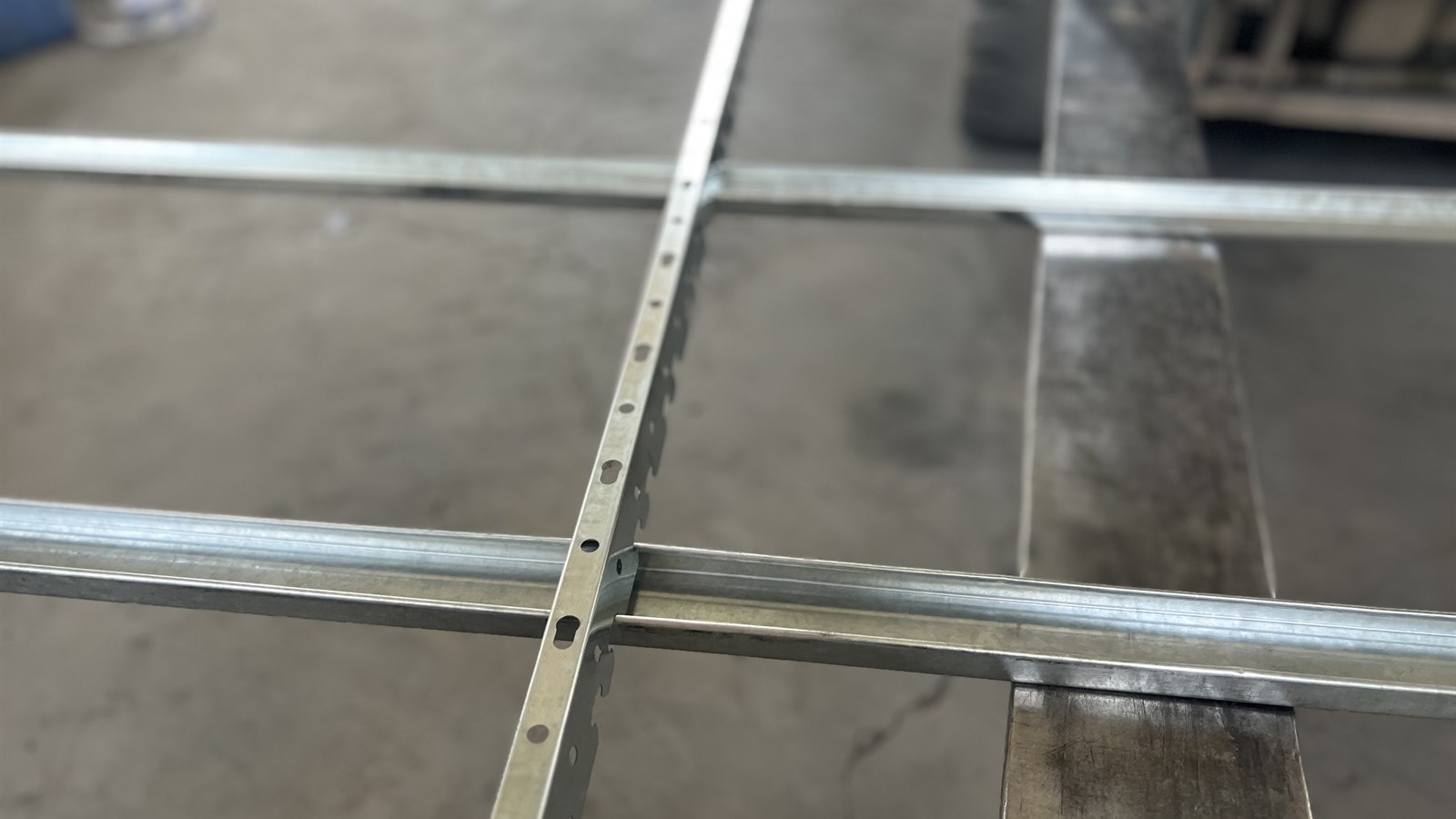
The shared-drive photo selected for this article shows a punched galvanized stud crossing a floor track in a simple workshop check. It is not a finished project wall, and that is exactly why it is useful. The image makes the matching issue visible. A stud profile, a track profile and a service-hole pattern are not separate purchasing thoughts once installers begin setting out a room. If the track package is delayed, mixed or described differently from the studs, the crew loses time before the first board reaches the wall. Drywall metal stud selection should therefore include the track at the same time. Buyers should confirm which track matches each stud width, how the package will be named on labels, and whether short wall groups or repeated room packages need to be separated in packing. This is especially useful when importers sell both loose stock and project-specific bundles. A warehouse team can move faster when the carton or bundle language mirrors the wall package, not just the factory item code.
Openings and services change the useful profile conversation
Openings usually expose weak planning faster than flat wall runs. Door zones, returns and service routes interrupt the rhythm of repeated studs. Chengyu's website states that OEM options can include custom thickness, length, punching and packing for light steel keel products. The practical question is not whether a buyer can request options. It is whether those options are tied to the room types that will actually need them. If a project includes many repeated office partitions, the buyer may focus on consistent length, easy identification and predictable stud-and-track matching. If the order is for hotel corridors, apartment layouts or healthcare support areas, the discussion often moves toward openings, short returns, service coordination and release sequence. A punched profile can help service routing, but only when hole position, profile orientation and jobsite expectation are reviewed against the drawing package. Random punching is not coordination. It needs to be part of the selection record.
Lengths and packing affect installation speed
Profile length is a technical choice, a packing choice and a receiving choice at the same time. Longer pieces can reduce cutting on some repeated wall runs, but they need clear handling space in the warehouse and on the project. Shorter or grouped releases may suit renovation floors, small rooms or local distribution better. The right answer depends on how the order will be unloaded, stored and handed to installers. This is where drywall metal stud selection connects directly with export packing. Chengyu's product pages already mention packing customization and coordinated supply across framing and ceiling components. For a distributor, the useful instruction is often simple: keep the repeated room packages easy to identify, keep special opening or service-zone material away from generic stock, and make the first installation release visible without opening every bundle.
Do not let one sample decide the whole building
Samples are useful because they make the metal real. They show profile shape, flange feel, punched holes and the way studs sit with track. But a single sample cannot carry the full project decision. Buyers still need to compare it with room use, wall sequence, board schedule, ceiling interface and the way materials will be split after arrival. A neat sample on a table does not tell the receiving team which bundle belongs to the first corridor or which studs should stay with a door-heavy room group. A better review is short but specific. Confirm the room families. Confirm stud and track matching. Confirm width, flange, gauge and length against the project drawings. Confirm whether punching is required. Confirm how labels will describe each package after import. Then check whether the packing plan supports the order in which the work will start. That is not overcomplication; it is the practical difference between buying metal profiles and buying a framing package that a crew can actually use.
A cleaner inquiry makes a cleaner shipment
For contractors and project buyers, the goal is not to turn every wall into a special product. The goal is to avoid forcing one vague description to cover several different site conditions. For distributors, the same thinking helps with repeat stock. A well-described drywall metal stud selection can support office partitions, hotel rooms, apartments and service areas without confusing the warehouse or the installer. The best inquiries usually read like a jobsite handoff: here are the room types, here are the repeated wall groups, here are the openings and service routes, here is the preferred length and packing logic. With that information, a supplier can discuss galvanized stud and track options more clearly, and the buyer can compare offers on more than price per piece. The result is a framing order that arrives with fewer surprises and gives the first crew a better chance of starting work without sorting the shipment twice.