Drywall Framing Coordination
Drywall Metal Stud Corridor Staging Before Board Crews
How contractors and buyers stage studs, tracks, openings and labels along corridor runs before board crews arrive.
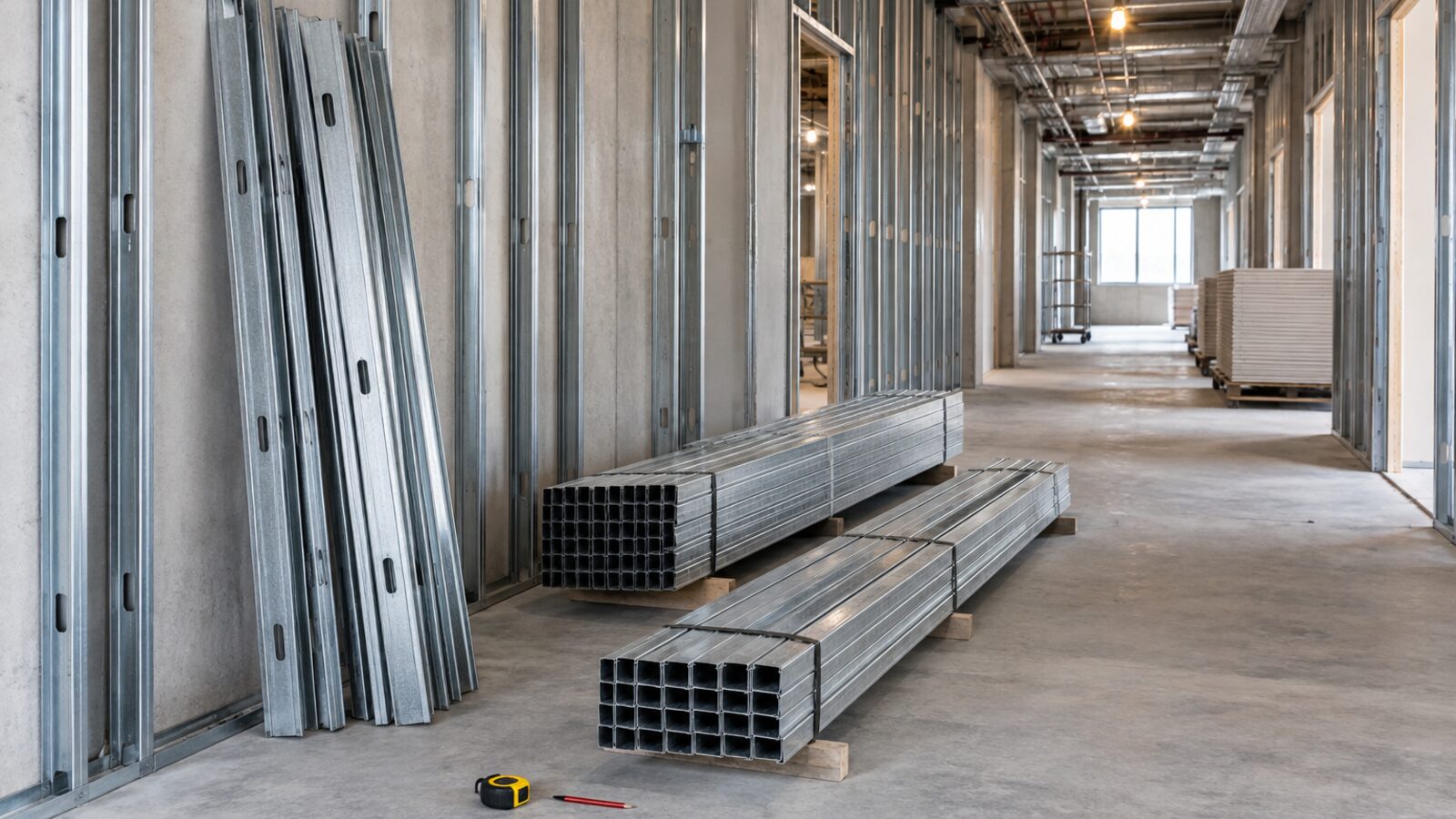
Corridor staging starts after the track line is trusted
Drywall metal stud corridor staging is the point where a long partition run stops being only a drawing and becomes a working route. The floor track may already be fixed, the head track may be marked above, and the board crew is waiting for a frame that can move without constant sorting. If the corridor material is still a mixed bundle at one end of the floor, every opening, return and service point becomes slower than it should be. Chengyu's light steel keel content describes galvanized studs, tracks, furring channels and carrying channels for commercial interior construction. It also asks buyers to confirm profile width, flange, steel thickness, length, punching, finish, bundle labels and export packing. Those details are useful on the purchase order, but they also matter at the corridor. A clean stage keeps the ordered profile roles visible while the installers are still making decisions.
Separate corridor runs from room piles
Corridors pull material differently from small rooms. A meeting room may need a compact set of studs and tracks around four sides. A corridor often needs repeated lengths, door openings, service interruptions and returns into rooms. When all profiles are staged as one floor pile, the corridor team starts walking back and forth for the same sizes, and room crews may borrow pieces that should have stayed with the run. A better habit is to stage corridor stock as a named release group. Studs, floor track, head track and any related channels can be placed along the route in the order the wall will be framed. The stacks should stay clear of walking lanes and door openings, with enough space to lift profiles without scraping finished faces or bending thin edges. It is simple site housekeeping, but it protects the rhythm of the run.
Keep studs and tracks as matched decisions
A drywall partition is not built from loose studs alone. The track line controls the wall location, and the studs make sense only when they match that line, the wall height and the room release. Chengyu's product information describes vertical metal studs with matching floor and head tracks as the basic partition system. That pairing should remain visible in the corridor staging area. On a busy floor, the risk is not usually that the crew cannot identify a stud. The risk is that a track bundle, a shorter stud group or a punched profile gets separated from the part of the run where it was meant to be used. Marking release groups by corridor zone, opening zone or floor section gives installers a second check before they start loading vertical members.
Openings should slow the staging plan, not the crew
Door openings and side-room entries break the repetition of a corridor. They may need additional studs, short track pieces, backing locations or clearer spacing around the frame. If those pieces are discovered only after standard studs have been stood in a straight line, the crew has to pause, remove material and rebuild the rhythm of the wall. Corridor staging works better when openings are treated as small packages inside the run. Profiles for each opening can be kept near the bay where they will be used, while standard studs remain grouped for the uninterrupted sections. The goal is not to create a warehouse inside the building. It is to stop special conditions from hiding inside a standard bundle until the board crew is already asking for access.
Punched studs need clear route logic
Chengyu lists punching as one of the details buyers can specify for light steel keel and drywall profiles. On site, punched studs are most useful when their service route is planned before the wall is closed. A corridor usually carries more repeated services than a single office, so the staging team should avoid mixing punched and unpunched studs without a reason. The practical check is visual. If punched studs are required in one section, they should be grouped and released with that section instead of being scattered across the run. If the project needs unpunched profiles in another area, those should stay separate as well. Good drywall metal stud corridor staging keeps the service path readable before gypsum board fixes the decision in place.
Labels should survive the first unload
Labels are often clear at the warehouse and unclear by the time the material reaches the work face. Cartons get opened, bundles are split and the person checking the order may not be the person who sent the RFQ. Chengyu's site already connects labels and export packing with profile orders, which is why the label should be treated as a jobsite tool rather than only a shipping mark. For corridor work, a useful label points to profile role, size, length, punching where relevant and release group. If a bundle is split into smaller staging piles, the same information should follow the material. A marker tag, pallet note or room-zone sheet can be enough. What matters is that the corridor team can tell which stock belongs to the next wall section without opening every bundle twice.
Board crews need a visible frame, not a hidden promise
The handoff to gypsum board crews should happen after the frame can be read in place. Tracks are aligned, studs are loaded in the correct zones, openings are clear, and service routes are not guessing games. When that check happens early, the board crew spends more time fixing board and less time waiting for a missing profile to be found behind another stack. This is also where distributors and project buyers can improve the inquiry. A useful RFQ for corridor partition work names the stud and track sizes, length groups, punching requirements, finish, approximate release zones, label wording and packing preference. The factory cannot control the site corridor, but clear order language gives the contractor better material to stage. From there, drywall metal stud corridor staging becomes a practical bridge between a correct shipment and a board-ready wall.