Export Logistics
Ceiling System Container Loading for Mixed Export Orders
How mixed ceiling orders should be staged so profiles, grid and board unload in the same logic they were sold.
The load is decided before the forklift turns
Ceiling system container loading usually looks like a warehouse task from a distance. Up close, it behaves more like site coordination. The hard part is rarely getting material through the container door. The hard part is deciding what the receiving team will see first when that door opens weeks later. On mixed export orders, painted T grid cartons, wall angle, drywall framing profiles, accessories and mineral fiber board may all be moving under one purchase order. If they enter the container in whatever sequence happened to be nearest the loading lane, the buyer inherits a sorting job before installation can even begin. Chengyu's current website already treats those items as one coordinated system rather than isolated stock lines. The product pages present ceiling grid, mineral fiber board, framing members and accessories as matched order components, and the factory and FAQ content already mentions labels, cartons, pallets and container loading support. That makes loading a commercial decision, not a last-minute warehouse reaction. When the order is reviewed as a system, the container should reflect the same logic. When it is reviewed only as tonnage and carton count, the confusion is simply moved downstream.
Long cartons and board pallets do not behave the same way
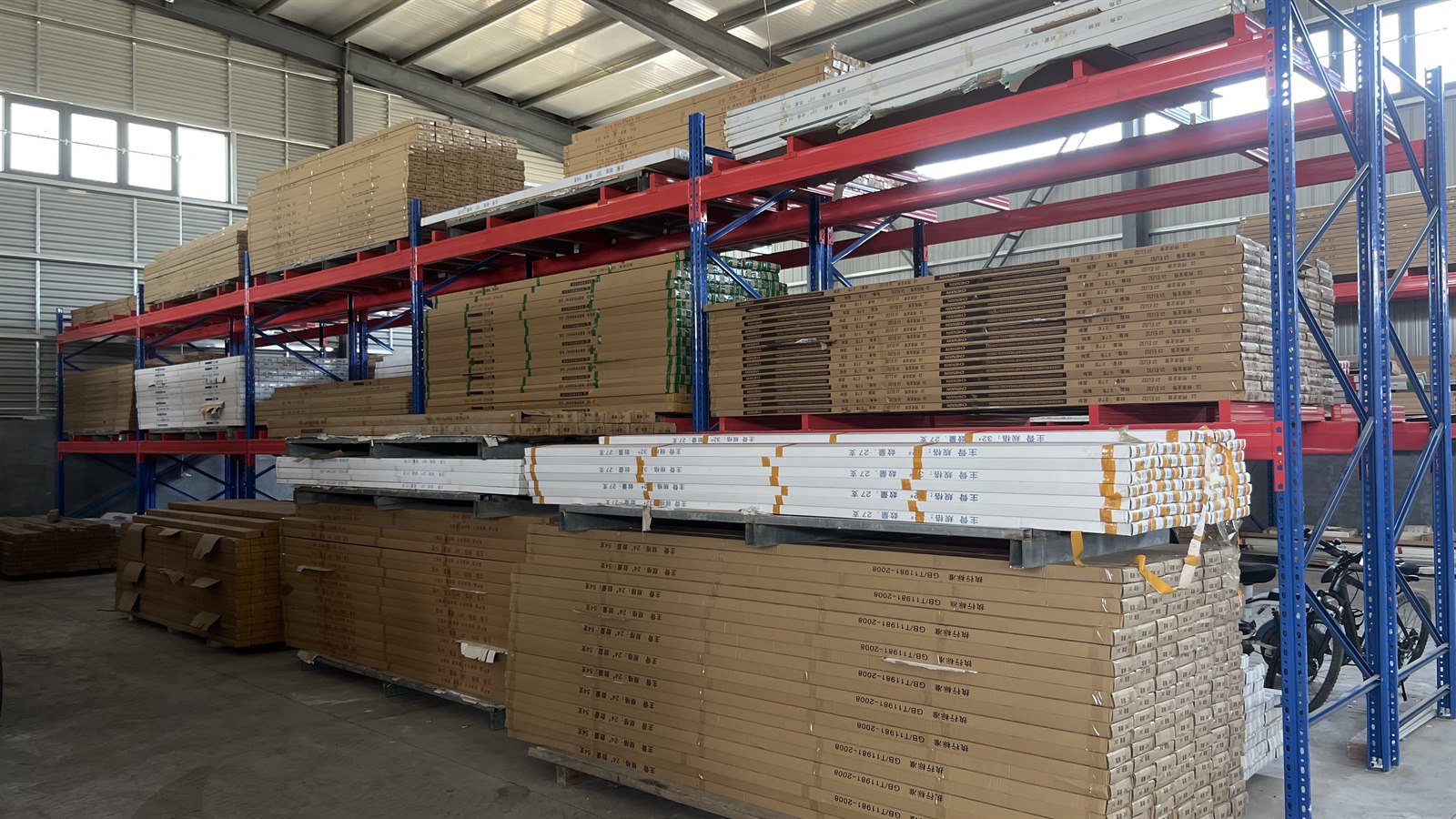
The shared-drive warehouse image makes one point immediately clear: long profile cartons and palletized board are not interchangeable cargo. Main tees, wall angle, studs, tracks and related long pieces want straight support, clear identity and a loading sequence that avoids needless reshuffling. Mineral fiber board cartons want square pallet stacks, visible size marks and enough stability that the receiving team does not have to rebuild the stack after unloading. Both product groups belong to the same ceiling system, but they do not tolerate the same kind of handling. That difference matters most on mixed loads. If long cartons are buried under item groups that will be released later, unloaders start dragging and resorting instead of transferring material cleanly. If board pallets are pushed into odd gaps after the profile sequence has already been set, the load may still fit, but the shipment becomes harder to count and harder to release by area. A practical loading plan respects the shape of each item group before it tries to optimize every cubic corner of the container.
Pack around the first unload, not the last empty space
Many overseas buyers do not receive a ceiling order as one uninterrupted installation package. A distributor may split the shipment into several local deliveries. A contractor may release material by floor, wing or room family. A project buyer may need the standard field areas first while service-heavy rooms wait for another trade. That is why ceiling system container loading should start with a simple question: which part of this order needs to come out first once the container reaches its destination? The answer often reshapes the load. Repeated room packages can stay together. Special lengths, border trims and matched accessories can travel with the area they belong to instead of being scattered wherever a gap appears. If one part of the order supports an early ceiling grid release and another part is intended for later rooms, the container should show that difference physically. Filling the container tightly still matters, but filling it blindly creates a slower result than leaving clear logic in the load.
Mixed orders need visible boundaries
Mixed ceiling orders tend to look deceptively uniform once they are wrapped and stacked. Brown long cartons line up neatly. White board cartons repeat the same faces. From a few meters away, almost everything starts to look compatible even when the contents belong to different room types or different item groups. That is where visible boundaries earn their value. Clear labels, separate stack zones and readable carton faces let the unloading team work from what it can see instead of from memory or guesswork. This is especially relevant when one order includes more than one board module, more than one exposed grid face width, or several profile lengths under the same shipment. Chengyu's existing product content already asks buyers to confirm size, length, thickness, labels and packing details during quotation. Container loading is where those decisions become useful in the real world. A clean label does not only support export documents. It helps the receiver separate standard field material from special items before the first pallet is moved off the truck.
Do not bury the pieces that control installation
Large bundles dominate the eye, but small matched components often decide whether the ceiling crew can actually start. A field of main tees is not much help if the wall angle for the perimeter is trapped behind unrelated stock. Mineral fiber board cannot be released cleanly if the correct grid accessories have disappeared into the center of a mixed load. The same problem appears on framing orders when short related pieces are treated as leftover space fillers rather than as part of the installation sequence. Experienced buyers therefore pay attention to access items before the container is sealed. They ask where the perimeter trim sits, whether accessory cartons can be identified without unloading half the order, and whether one room package can be issued without disturbing another. Those are modest questions, but they protect the next handoff. On busy jobs, installation delay often begins with one missing supporting item rather than with the major material line everyone remembered to count.
Close the container with the next handoff in mind
A final loading check should sound less like freight paperwork and more like a receiving rehearsal. Can the destination team recognize the item groups quickly? Are the visible carton faces enough to distinguish board size and product family? Do the first materials behind the door match the first area scheduled for release? Will the warehouse crew have to break a stable stack just to find one accessory group? If those questions feel awkward at loading time, they become expensive after arrival. That is why ceiling system container loading deserves a place in the buying conversation alongside module selection, profile length and packing method. The container is the last point where the order can still be organized at low cost. Once it is closed, every unclear decision travels with it. When long cartons, board pallets and matched accessory groups are staged in the same sequence they will be unloaded and issued, the shipment lands cleaner, the site spends less time resorting, and the ceiling package behaves like one coordinated system.